Teaching
Teaching experience at Fordham University and the University of Sydney.
Course Design: Data Science and AI for Business
I independently designed and developed the entire course from scratch, including all lectures, assignments, and solutions. The course has been approved by the Coordinator of Doctoral Studies at the Gabelli School of Business, Fordham University. Prospective employers are welcome to contact me for the complete course package, including slides, assignments, solutions, and syllabus.
This course introduces PhD students to modern data science and AI methods with direct applications to business and finance research. The curriculum covers four areas: (1) how to extract meaning from text using natural language processing and large language models; (2) how to model relationships in financial and economic networks using graph neural networks; (3) how to forecast and make sequential decisions using time series models and reinforcement learning; and (4) how to work with non-traditional data sources including audio and video. Each section balances foundational theory with hands-on implementation and research applications.
Section 1: Textual Analysis and Language Models for Business
A few examples are shared below. Additional materials available upon request.
| Lecture 0: Math and Python Foundations | Slides |
| Lecture 1: Introduction and Word Vectors | Slides |
| Lecture 2: From Embeddings to Neural Networks | Slides |
| Lecture 3: Language Models, Transformers, and FinBERT | Slides |
| Lecture 3b: The Mathematics of Attention and Transformers | Slides |
| Lecture 4: From BERT to GPT — Pretraining, Tokenization, and Scaling | Slides |
| Lecture 5: Post-Training, Alignment, and LLMs for Finance | Slides |
Assignment 1A: Technological Peer Pressure and Product Disclosure 
This assignment studies how firms adjust product disclosures under technological peer pressure. Part A constructs measures of technology similarity using patent data and vector space methods. Part B measures product disclosure through three progressively sophisticated NLP approaches: keyword matching, Word2Vec dictionary expansion, and fine-tuning FinBERT for supervised classification.
Required Reading for Assignment 1A:
- Cao, S. S., Ma, G., Tucker, J. W., and Wan, C. (2018). Technological peer pressure and product disclosure. The Accounting Review, 93(6), 95–126.
- Li, K., Mai, F., Shen, R., and Yan, X. (2021). Measuring corporate culture using machine learning. Review of Financial Studies, 34(7), 3265–3315.
- Li, K., Mai, F., Shen, R., Yang, C., and Zhang, T. (2026). Dissecting corporate culture using generative AI. Review of Financial Studies, 39(1), 253–296.
- Huang, A. H., Wang, H., and Yang, Y. (2023). FinBERT: A large language model for extracting information from financial text. Contemporary Accounting Research, 40(2), 806–841.
Assignment 1B: Generative AI Exposure from Occupation-Level to Firm-Level
Construct an ex-ante firm-level generative AI exposure measure, starting from occupation-level data and aggregating to the firm level.
Eisfeldt et al. (2026) Example Data
Required Reading for Assignment 1B:
- Eisfeldt, A. L., Schubert, G., Taska, B., and Zhang, M. B. (2026). Generative AI and firm values. Journal of Finance, forthcoming.
Section 2: Network Analysis and Graph Neural Networks for Business
Materials available to enrolled students. Slides and assignments will be shared upon request.
Section 3: Time Series Models and Reinforcement Learning for Business
Materials available to enrolled students. Slides and assignments will be shared upon request.
Section 4: Alternative Data Extraction: Voice and Video
Materials available to enrolled students. Slides and assignments will be shared upon request.
Fordham Gabelli School of Business
Instructor, BPHD 8063 Data Science and AI for Business (PhD) — Spring 2026
Guest Lecture, Intro to Fintech in Portfolio Management (GFGB 700T / FNGB 74CL) — Spring 2026
Guest Lecture, Machine Learning & Econometrics — Fall 2025
University of Sydney Business School
Head Tutor, FINC5001 Foundation in Finance (Postgraduate) — Spring 2022 – Spring 2025
Tutor, FINC6001 Finance: Theory to Applications (Postgraduate) — Spring 2024 – Spring 2025
Tutor, FINC6010 Derivative Securities (Postgraduate) — Spring 2022 – Fall 2023
Tutor, FINC2011 Corporate Finance I (Undergraduate) — Fall 2019
Tutor, FINC3012 Derivative Securities (Undergraduate) — Fall 2019
Teaching Awards
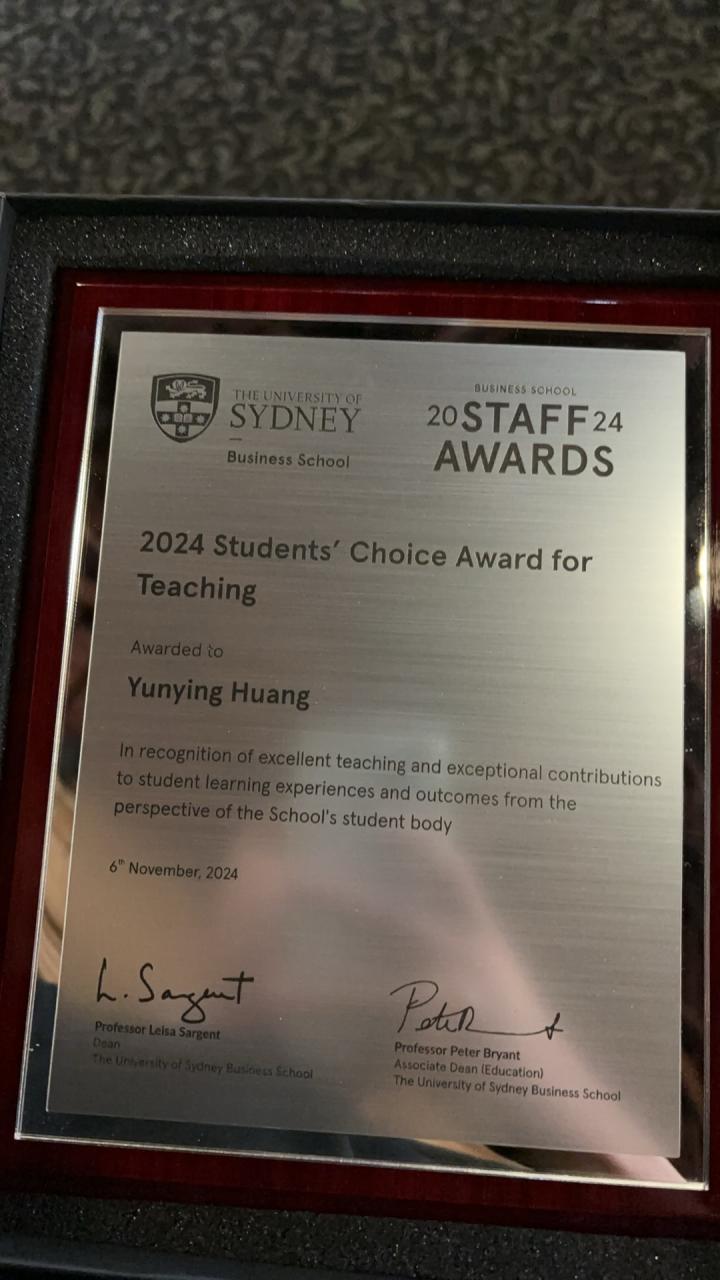
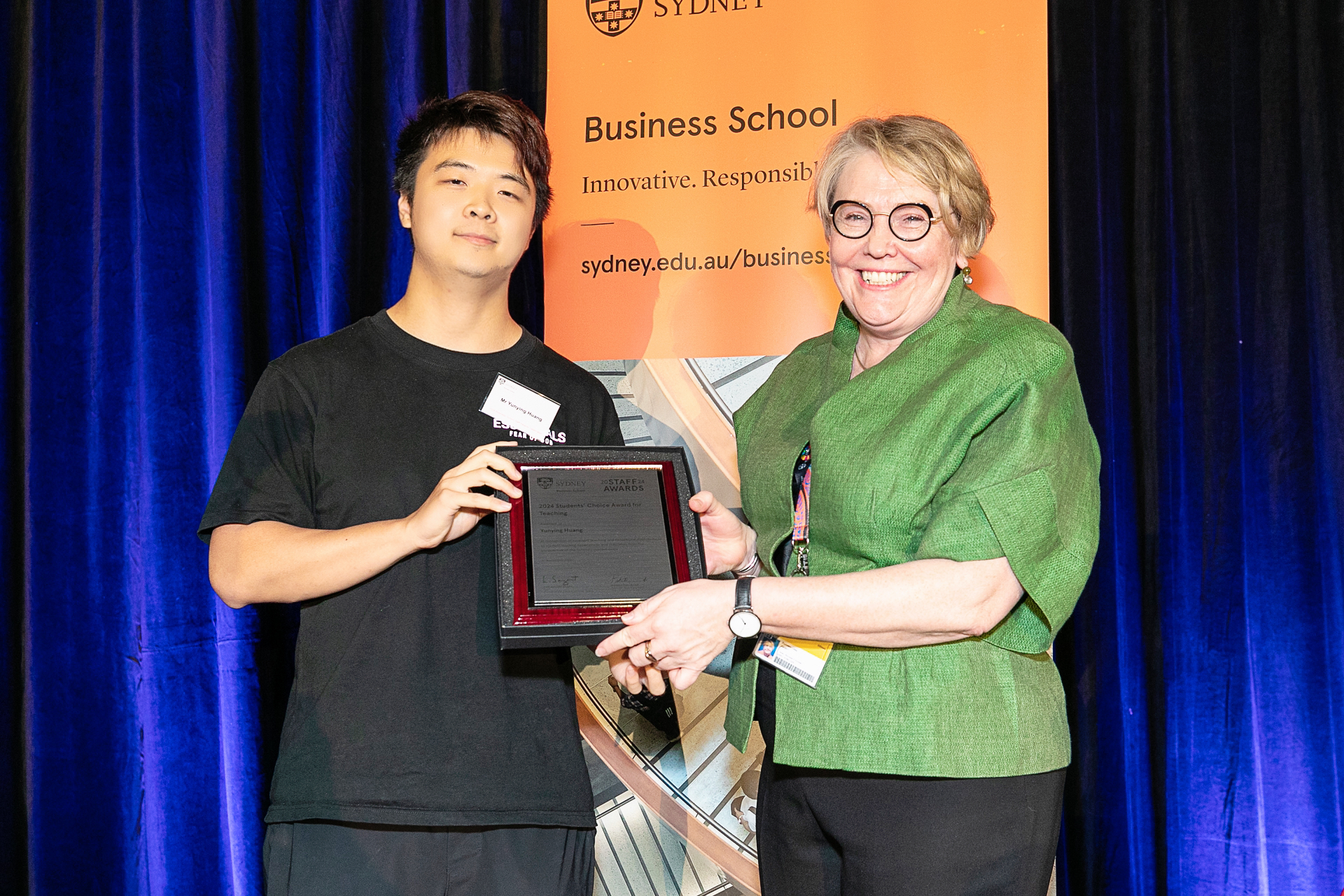
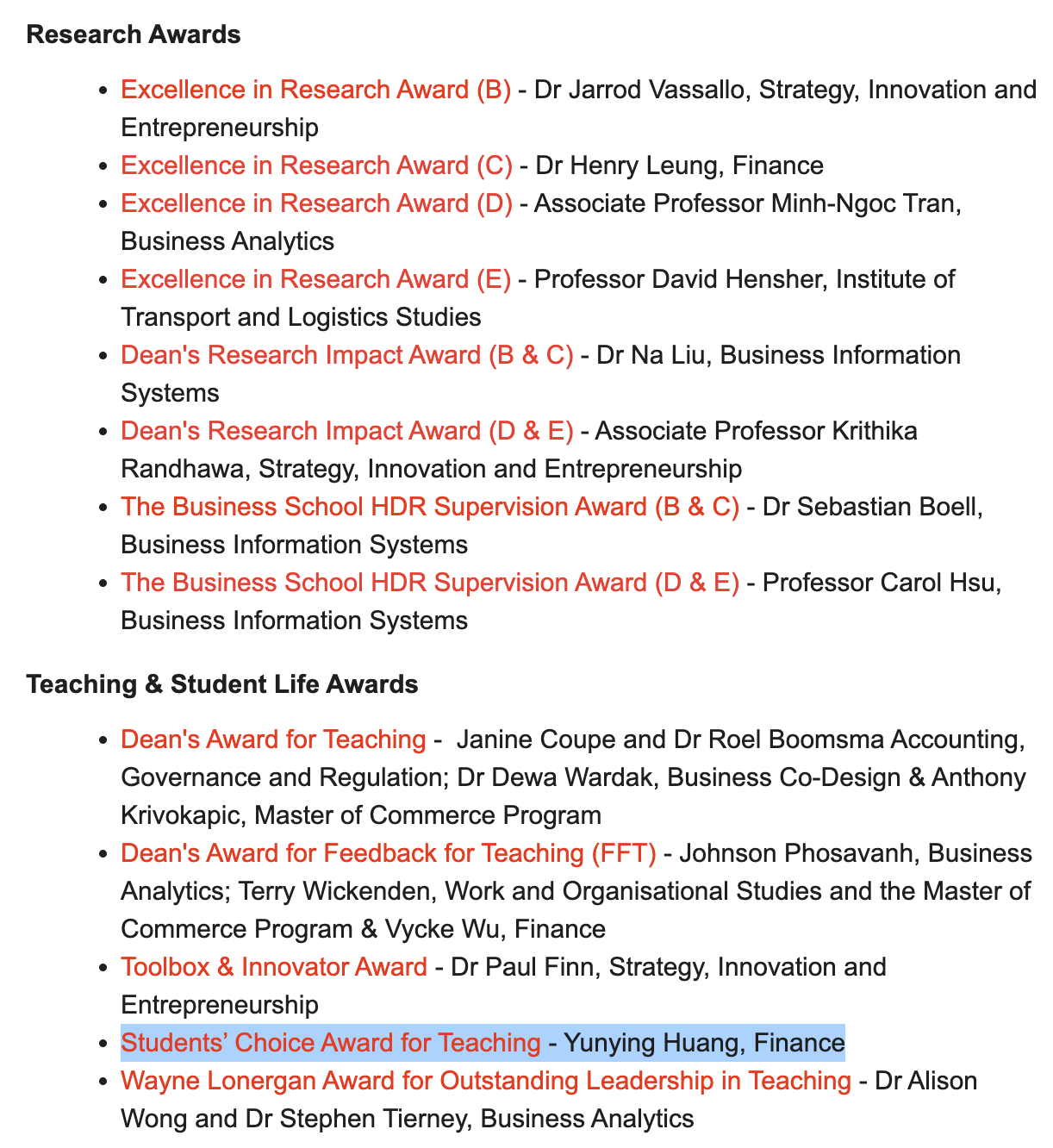
Students’ Choice Award for Teaching, University of Sydney Business School, 2024
- Sole recipient; first winner from the Finance discipline
Students’ Choice Award for Teaching, Nominee, 2023
Dean’s Award for Feedback for Teaching, Nominee, 2023
Feedback for Teaching Award (Semester 1 & 2), 2022, 2023